
How to Choose a Custom Home Builder in Sydney: 7 Things Every Homeowner Should Know Before Signing a Contract
Imagine this.
You've finally found the perfect block of land.
Or maybe you've decided it's time to knock down the family home and build the one you've always imagined.
You've spent months collecting inspiration, saving photos, talking to friends and dreaming about what life could look like once it's finished.
Now you've reached the next step.
Choosing a builder.
It sounds simple enough.
Until the quotes start arriving.
One builder promises exceptional quality.
Another says they'll finish faster.
Another comes in tens of thousands of dollars cheaper.
Every website looks impressive.
Every portfolio showcases beautiful homes.
Every builder says they're different.
So...
How do you actually know who's right for your project?
For many homeowners, this is where excitement turns into uncertainty.
And it's completely understandable.
Unlike buying a car or renovating a kitchen, building a custom home isn't something most people do every day. For many families, it's a once-in-a-lifetime decision.
Which means you don't get many opportunities to learn from experience.
The builder you choose won't just influence the finished home.
They'll influence the entire journey.
How clearly things are explained.
How problems are solved.
How confident you feel throughout construction.
And ultimately, whether building your dream home becomes an exciting experience—or one you'd rather forget.
The good news?
Choosing a builder doesn't have to feel overwhelming.
Once you know what to look for, comparing builders becomes much easier.
This guide will walk you through the seven things that matter most, the warning signs worth paying attention to, and how to compare builders with confidence before signing a contract.
Before We Compare Builders...
Let's clear up one of the biggest misconceptions in residential construction.
Not all builders operate the same way.
It sounds obvious.
But many homeowners don't realise just how different one building company can be from another until they're already halfway through the process.
Some builders construct hundreds of homes every year.
Others only build a handful.
Some specialise in standard designs.
Others create completely bespoke homes.
Neither approach is automatically better.
It simply depends on what you're trying to achieve.
Understanding those differences is the first step towards choosing the right builder.
Compare Builders Side by Side
We’ve created a free Homeowner’s Builder Comparison Workbook to help you keep your notes, questions and key differences in one place.
Custom Builder vs Volume Builder
If you've only recently started researching builders, you've probably come across the terms custom builder and volume builder.
At first glance, they can seem similar.
Both build homes.
Both aim to deliver a finished product you're proud to call home.
But the experience can be very different.
Volume Builders
Volume builders typically construct a large number of homes each year using a catalogue of pre-designed floor plans.
Their systems are built around consistency and efficiency.
For homeowners looking for a straightforward home with limited customisation, this can be a practical option.
Because the designs and construction processes are already established, projects often follow a structured workflow with clearly defined selections and inclusions.
However, that efficiency can also mean less flexibility.
Making significant design changes, selecting unique materials or adapting a home to suit a complex site may not always be as straightforward.
Homeowners also tend to work with several different people throughout the journey, from sales consultants and estimators through to contract administrators and site supervisors.
Custom Builders
Custom builders take a different approach.
Instead of starting with a catalogue, they start with you.
Your land.
Your lifestyle.
Your family's needs.
Your long-term goals.
Every project is designed around those priorities.
That often means working closely with architects, interior designers, engineers and specialist consultants to create a home that responds to the site rather than trying to make the site fit a standard design.
The result isn't simply a different house.
It's a different building experience.
One built around collaboration, flexibility and personalised advice from the very beginning.
If you're building a forever home, a knockdown rebuild or an architect-designed residence, this level of collaboration is often one of the biggest advantages of working with a custom builder.
Boutique, Director-Led Builders
Within the custom building industry, you'll also come across boutique, director-led builders.
Rather than managing a high volume of projects, these businesses generally focus on delivering a smaller number of homes with greater personal involvement.
That often means the person you first meet remains closely involved throughout your project.
Questions are answered by someone who already understands your goals.
Decisions can often be made more quickly.
Communication stays consistent.
For many homeowners, that's reassuring.
Not because one approach is necessarily better than another...
…but because knowing who's responsible throughout the journey provides confidence from day one.
And when you're making one of the biggest investments of your life, confidence matters.
So, How Do You Separate Great Builders From Good Marketing?
Now that you understand the different types of builders, another question naturally follows.
How do you compare them?
Because here's the reality.
You could meet three builders next week.
All three might have beautiful websites.
Excellent reviews.
Professional presentations.
And competitive quotes.
At first glance...
they might all seem like the right choice.
But that's exactly where many homeowners get stuck.
The difference isn't always obvious.
Until you know what to look for.
Let's start with the first—and arguably the most important—thing to consider.
1. Find Out Who Will Actually Be Managing Your Project
One simple question can reveal a surprising amount about how a builder operates.
"Who will actually be managing my project?"
Many homeowners assume the person they first meet is the person they'll continue working with throughout construction.
Sometimes that's true.
Often, it isn't.
Depending on the company, your project may be handed from sales consultants to estimators, contract administrators and site supervisors before construction even begins.
There's nothing inherently wrong with that model.
But it's important to understand how it works before signing a contract.
Knowing who you'll communicate with, who'll make decisions and who'll ultimately be accountable for your project can help set clear expectations from the very beginning.
After all, you're not simply choosing a company.
You're choosing the people you'll trust with one of the biggest investments of your life for the next 12 to 18 months.
2. Look Beyond the Finished Photos

Let's be honest.
Every builder has beautiful photos.
Modern kitchens.
Luxury bathrooms.
Perfectly styled living rooms.
If you judged builders by their Instagram feed alone, almost everyone would look like the right choice.
But here's the problem.
Beautiful photography tells you what a home looks like.
It doesn't tell you how it was built.
That's where many homeowners get caught out.
A polished portfolio might show the finished product, but it won't tell you how challenges were handled, how well the project was managed or what the client experienced throughout the build.
So instead of asking:
"Can they build a beautiful home?"
Ask something far more valuable.
"Can they consistently deliver a great building experience?"
A few ways to find out include:
Looking for completed projects rather than just renders.
Reading detailed client reviews, not just star ratings.
Asking how they approached challenges on previous builds.
Requesting case studies of homes similar to yours.
The goal isn't to find the builder with the most impressive marketing.
It's to find one with a proven track record of delivering quality homes and positive client experiences.
3. Don't Compare Quotes. Compare Value.
Imagine receiving three quotes for exactly the same project.
One is significantly cheaper.
One sits in the middle.
One is noticeably higher.
Which one should you choose?
Most people instinctively look at the price first.
It's understandable.
Building a home is a significant investment.
But here's something many homeowners discover too late.
Not all quotes include the same things.
One builder may have allowed for premium finishes.
Another may have included site costs.
Another may have left several items to be confirmed later.
On paper, they all look like quotations.
In reality, they may be pricing very different projects.
Instead of asking only:
"How much?"
Try asking:
What's included?
What's excluded?
How have allowances been calculated?
How are variations managed?
What assumptions have been made?
Those answers often tell you far more than the final number.
If you're still working out your overall budget, our Premium Home Build Cost Guide explains the key factors that influence the cost of building a premium home and is a helpful companion to this guide.
Because before comparing builders...
it's worth understanding what you're actually comparing.
4. Are They Properly Qualified, Licensed and Experienced?
Before looking at how long a builder has been in business or how impressive their portfolio is, start with something more fundamental.
Are they properly licensed and appropriately insured for the work they're proposing to do?
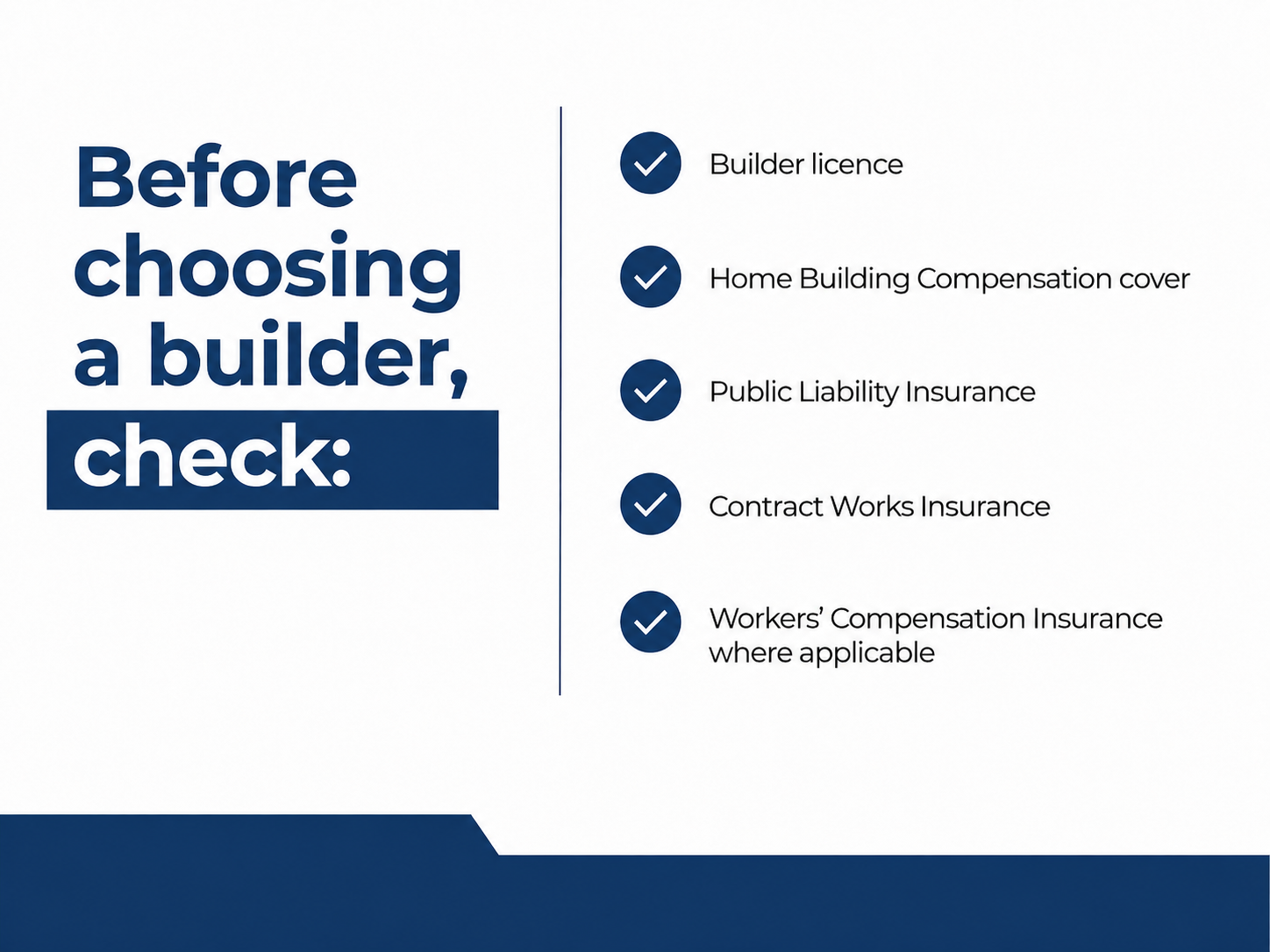
Builder Licence
In NSW, a contractor licence is required for residential building work valued at more than $5,000, including labour, materials and GST.
Don't simply ask a builder whether they're licensed.
Ask for their licence number and check that:
the licence is current;
the details match the builder or company you're contracting with; and
the licence covers the type of residential building work you're planning.
A valid licence helps confirm that the builder is legally authorised to carry out the work.
For a homeowner, checking this early is a simple step that can help avoid unnecessary legal, financial and project risk later.
Insurance & Financial Protection
Licensing is only part of the picture.
You should also understand what insurance and financial protections will apply while your home is being built.
Home Building Compensation Cover
For eligible residential building work valued at more than $20,000 including GST, the builder must arrange Home Building Compensation cover for the individual project.
Before paying any money—including a deposit—or allowing work to begin, ask to see the Certificate of Insurance for your specific project.
This cover acts as a last-resort safety net in certain circumstances if the builder cannot complete the work or meet their warranty obligations.
Don't rely only on being told the builder is eligible for cover.
Ask for the actual certificate relating to your home.
Public Liability Insurance
Ask whether the builder holds current Public Liability Insurance and whether they can provide evidence of that cover.
This helps protect against claims involving personal injury or property damage to third parties arising from the building works.
For example, if construction activities cause injury or damage involving a homeowner, neighbour, visitor or surrounding property, appropriate Public Liability cover can be an important protection.
Contract Works Insurance
It's also worth asking what Contract Works Insurance will protect your project while construction is underway.
This type of insurance generally protects the building works, materials and construction activities against insured events that may include fire, storm, theft, vandalism or accidental damage, depending on the policy.
For a homeowner, the important question is simple:
"If something damages the project while it's being built, what protection is in place?"
Workers' Compensation Insurance
Where a builder employs workers, they should also have the appropriate Workers' Compensation arrangements in place where required.
This provides protection for emploees who suffer a work-related injury or illness, including support such as medical costs and lost wages.
As the homeowner, you don't need to become an insurance expert.
But you should feel comfortable asking the builder to explain the cover they hold and provide appropriate evidence.
A Few Questions Worth Asking Before You Move Forward
What is your builder licence number?
Can I check that the licence is current and appropriate for my project?
Will you provide the Home Building Compensation Certificate of Insurance for my project before I pay a deposit?
Can you provide evidence of your current Public Liability Insurance?
What Contract Works Insurance will protect the project during construction?
Do you have the appropriate Workers' Compensation cover for the people you employ?
A professional builder should be comfortable answering these questions.
Once you've checked those fundamentals, then look at experience.
A builder may have been in business for 30 years.
That sounds impressive.
But here's a better question.
Have they built homes like yours?
There's a big difference between building:
a standard project home,
a luxury custom residence,
a duplex,
or a knockdown rebuild.
Each presents different challenges.
Different approvals.
Different construction methods.
Different levels of coordination.
If your project is architect-designed, ask whether they've worked closely with architects before.
If you're building on a sloping site, ask about similar projects.
If you're planning a duplex, ask how many they've completed recently.
The more closely their previous work reflects your project, the more confidence you can have in their ability to anticipate challenges before they become problems.
Experience isn't just about time.
It's about relevance.
5. Pay Attention to How They Communicate
Here's something homeowners rarely realise during the first meeting.
The way a builder communicates before you've signed a contract is often a preview of what it'll be like after you've signed one.
Do they answer your questions clearly?
Do they listen carefully?
Do they explain things in a way that's easy to understand?
Or do you leave the meeting feeling more confused than when you arrived?
Building a custom home involves hundreds of decisions over many months.
No matter how experienced your builder is, good communication will shape your experience just as much as good workmanship.
Ask questions like:
Who will be my main point of contact?
How often will I receive updates?
How are variations discussed?
Will there be regular site meetings?
What's the best way to contact you?
Remember...
You're not simply choosing someone to build your home.
You're choosing someone you'll be communicating with for the next year or more.
Choose someone who makes that feel easy.
6. Great Homes Are Built by Great Teams
People often imagine a builder working alone.
The reality couldn't be more different.
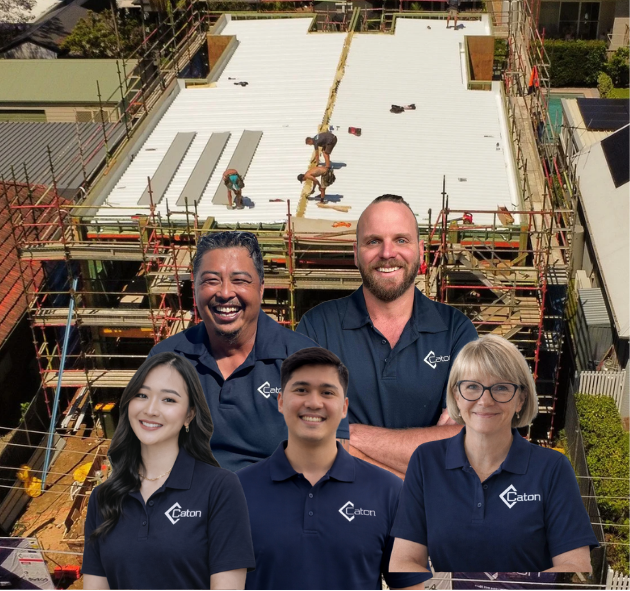
Behind every successful custom home is an entire team.
Architects.
Interior designers.
Engineers.
Surveyors.
Specialist trades.
Suppliers.
The best builders know how to bring all of those people together.
When everyone communicates well, problems are solved earlier.
Design intent is preserved.
Construction runs more smoothly.
And homeowners enjoy a far better experience.
If you're working with an architect or designer, ask builders how they collaborate with consultants throughout the project.
Their answer will tell you a lot about how they manage relationships—not just construction.
7. Reputation Is Earned Long Before You Meet Them
A builder's reputation doesn't begin with the first meeting.
It's built over years.
One project at a time.
Online reviews can be helpful.
But don't stop there.
Read the comments.
Look for recurring themes.
Do clients mention communication?
Professionalism?
Attention to detail?
Problem-solving?
Better yet...
Ask whether you can speak with previous clients.
Or visit a completed project.
There's something reassuring about standing inside a finished home and hearing directly from the people who built it.
Because while websites tell you what a builder wants you to know...
past clients often tell you what you actually need to know.
Here's Where Many Homeowners Get Caught Out...
By now, you probably have a good idea of what to look for.
But knowing what to look for is only half the equation.
The other half?
Recognising the warning signs before it's too late.
Because sometimes...
it's not the builder you choose that causes problems.
It's the warning signs you ignored along the way.
Ready to Compare Your Shortlist?
Use our free Builder Comparison Workbook to compare the builders you’re considering and keep everything in one place
The Red Flags You Should Never Ignore
Knowing what to look for is important.
But sometimes the smartest decision isn't knowing who to choose.
It's recognising who not to choose.
Most building problems don't appear overnight.
They're often preceded by small warning signs that are easy to dismiss during the excitement of planning a new home.
Here are seven worth paying attention to.
1. A Quote That Seems Too Good to Be True
Everyone appreciates value for money.
But if one quote is significantly lower than all the others, it's worth asking why.
Has something been left out?
Are allowances realistic?
Will additional costs appear later as variations?
A transparent builder should be able to explain exactly what's included and why their proposal has been prepared the way it has.
If they can't, it's worth asking more questions before moving forward.
2. Communication Is Difficult Before You've Even Signed
Think about your experience so far.
How easy has it been to organise meetings?
How quickly are emails returned?
Do you receive clear answers to your questions?
The early stages of your relationship often provide a good indication of what communication will look like once construction begins.
If you're struggling to get information now, it's reasonable to ask whether things will improve later.
3. They Can't Clearly Explain Their Process
Every builder has a process.
An experienced builder should be able to explain it clearly.
What happens after you sign?
When do selections happen?
How are variations managed?
Who coordinates consultants?
If those answers feel vague or inconsistent, don't be afraid to keep asking questions.
A clear process gives homeowners confidence.
4. They Avoid Talking About Variations
No homeowner wants unexpected costs.
While variations are sometimes unavoidable, they should never come as a surprise.
Ask how they're managed.
How are they priced?
How are they approved?
When are they discussed?
A builder who is transparent about variations is usually demonstrating transparency in other parts of the project too.
5. Their Portfolio Doesn't Reflect Your Project
A builder may have decades of experience.
But if you're planning a luxury custom home and most of their recent work is standard project homes, it's worth considering whether they're the right fit.
Choose a builder whose experience reflects the type of home you want to build—not just someone who's been building for a long time.
6. You Feel Pressured to Make a Decision
Building a custom home isn't a decision most people make overnight.
A good builder understands that.
You should have time to ask questions, compare options and feel confident before signing a contract.
If you feel rushed, pressured or discouraged from exploring your options, take a step back.
Confidence should come before commitment.
7. You're Not Sure Who's Accountable
Here's one final question worth asking.
"If I have a concern during construction, who do I call?"
The answer should be clear.
Understanding who'll be responsible for your project—and who'll be there to support you—can make a significant difference throughout your building journey.
So... How Do You Make the Final Decision?
By this point, you've probably realised something.
Choosing a builder isn't about finding the company with the biggest logo.
Or the cheapest quote.
Or even the most impressive website.
It's about finding the builder who gives you confidence.
The one who understands your goals.
Communicates clearly.
Has experience relevant to your project.
And demonstrates the transparency and professionalism you're looking for.
But after meeting several builders, remembering who said what can become surprisingly difficult.
Conversations blur together.
Quotes start looking similar.
Small details are forgotten.
That's exactly why comparing builders side by side is so valuable.
Download Your Free Homeowner's Builder Comparison Checklist
To make comparing builders easier, we've created The Homeowner's Builder Comparison Checklist.
Instead of relying on memory, this practical resource helps you evaluate each builder using the same criteria, making it easier to compare your options with confidence.
Inside you'll find:
✔ A builder comparison worksheet
✔ Quote and inclusions checklist
✔ Space for notes after each builder meeting
✔ Common red flags to watch for
✔ A simple decision scorecard to help compare your options
Whether you're meeting your first builder or narrowing your shortlist, it's designed to help you make a more informed decision.
Download your free copy below and take it with you to every builder meeting. As you compare your options, you'll have a consistent framework to help you make a confident, informed decision.
Final Thoughts
Building a custom home is one of the biggest investments you'll ever make.
But before construction begins, there's an even bigger decision to make.
Who do you trust to build it?
Don't rush the decision.
Meet more than one builder.
Ask thoughtful questions.
Compare your options using the same criteria.
And choose the builder who gives you confidence—not just the one who gives you the lowest quote.
Ready to Start the Conversation?
If you're planning a custom home, knockdown rebuild or duplex in Sydney, we'd love to help you take the next step.
Whether you're still exploring ideas or you're ready to begin planning, our team is happy to answer your questions and provide honest, practical advice.
Book a Discovery Callto discuss your project and find out whether Caton Constructions is the right fit for your home.
Frequently Asked Questions
How do I choose the right custom home builder?
Start by comparing more than just price. Look at the builder's experience, communication style, transparency, project management process and previous work. Meeting with more than one builder can also help you understand the differences and make a more confident decision.
What's the difference between a custom builder and a volume builder?
Volume builders typically work from a range of standard home designs using streamlined processes, while custom builders create homes tailored to each client's land, lifestyle and vision. The right choice depends on the type of home you want to build and the level of personalisation you're looking for.
Should I choose the cheapest building quote?
Not necessarily.
The lowest quote doesn't always represent the best value. Understanding what's included, how variations are managed and the level of service provided will often give you a better basis for comparison than price alone.