
Knockdown Rebuild Versus Renovation: Which Is Right for You?
If you love where you live but your home no longer works for your lifestyle, you will eventually face a big question:
Should you renovate the existing home, or knock it down and rebuild?
For many homeowners across the Sutherland Shire and surrounding Sydney areas, the answer is not immediately obvious.
Renovating can seem like the simpler option. You keep the existing house, retain the parts that work and improve the areas that do not.
A knockdown rebuild takes a different approach. Instead of working around the limitations of the existing home, you start again and design a new home around your block, lifestyle and long-term plans.
Neither option is automatically better.
The right decision depends on what you are trying to achieve, the condition and configuration of your existing home, your budget, your timeframe and what is possible on your site.
When comparing a knockdown rebuild vs renovation, we recommend looking at three things first:
Cost. Timeline. Outcome.
These three factors can help you move beyond the question of what appears cheaper today and focus instead on which option makes the most sense for your property and your future.
Renovate or Knock Down and Rebuild?
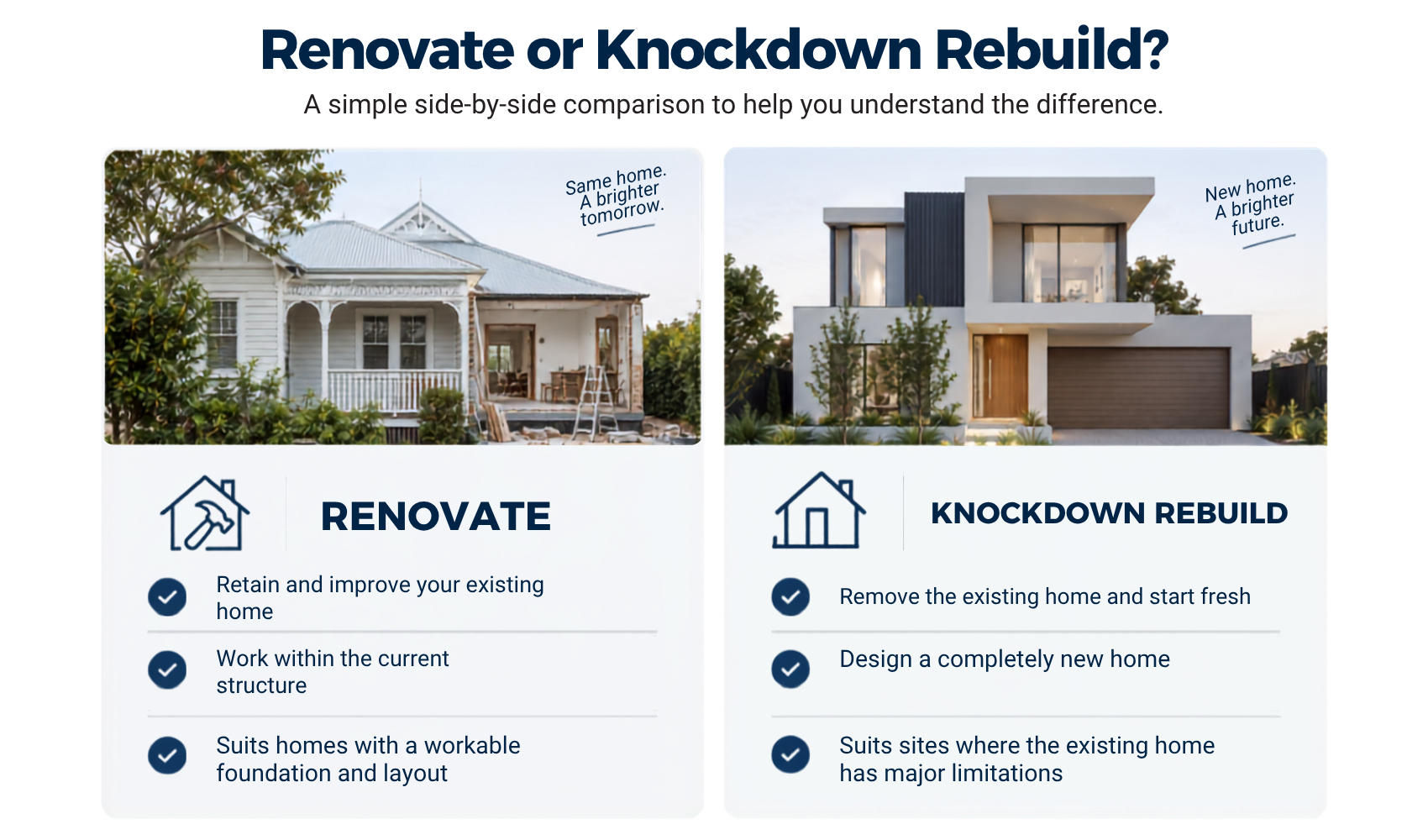
A renovation generally makes sense when the existing home has good foundations, a workable structure and a layout that can be adapted without completely rebuilding the property.
A knockdown rebuild may make more sense when the existing home has significant structural or layout limitations, requires extensive work throughout, or simply cannot be adapted into the home you want without major compromises.
The difficulty is that the decision is rarely as simple as comparing the cost of demolition with the cost of renovation.
A substantial renovation can involve structural changes, extensions, new services, internal reconfiguration and extensive upgrades to an ageing building.
Likewise, a knockdown rebuild involves more than constructing the new home. Demolition, site preparation, design, approvals and temporary accommodation may all need to be considered.
That is why the best starting point is to assess the entire project rather than one component of the cost.
1. Cost: Which Option Makes Better Financial Sense?
Cost is usually the first consideration for homeowners comparing renovation with a knockdown rebuild.
A renovation may initially appear to be the more affordable option because you are retaining part of the existing home. For smaller or carefully targeted renovations, that can certainly be true.
However, the equation can change considerably when the renovation becomes extensive.
When renovation can make financial sense
Renovating may be worth considering when:
The existing structure is in good condition.
The current floorplan is reasonably close to what you need.
Most of the home can be retained.
Structural changes are limited.
The project is focused on improving particular areas rather than completely transforming the house.
For example, updating a kitchen, bathrooms and finishes or adding a well-planned extension can provide a significant improvement without requiring the entire home to be rebuilt.
When renovation costs can grow
The more extensively you alter an existing building, the more complexity can be introduced.
Older homes may reveal conditions that were difficult to fully assess before work commenced. Existing services may need upgrading. Structural changes may require additional engineering, and new construction needs to integrate correctly with the existing building.
You may also find yourself spending considerable money solving the limitations of the old home before you can begin creating the new one.
This is one of the reasons homeowners should avoid assuming that renovation is automatically the cheaper option.
Understanding knockdown rebuild cost
A knockdown rebuild starts with a clean slate.
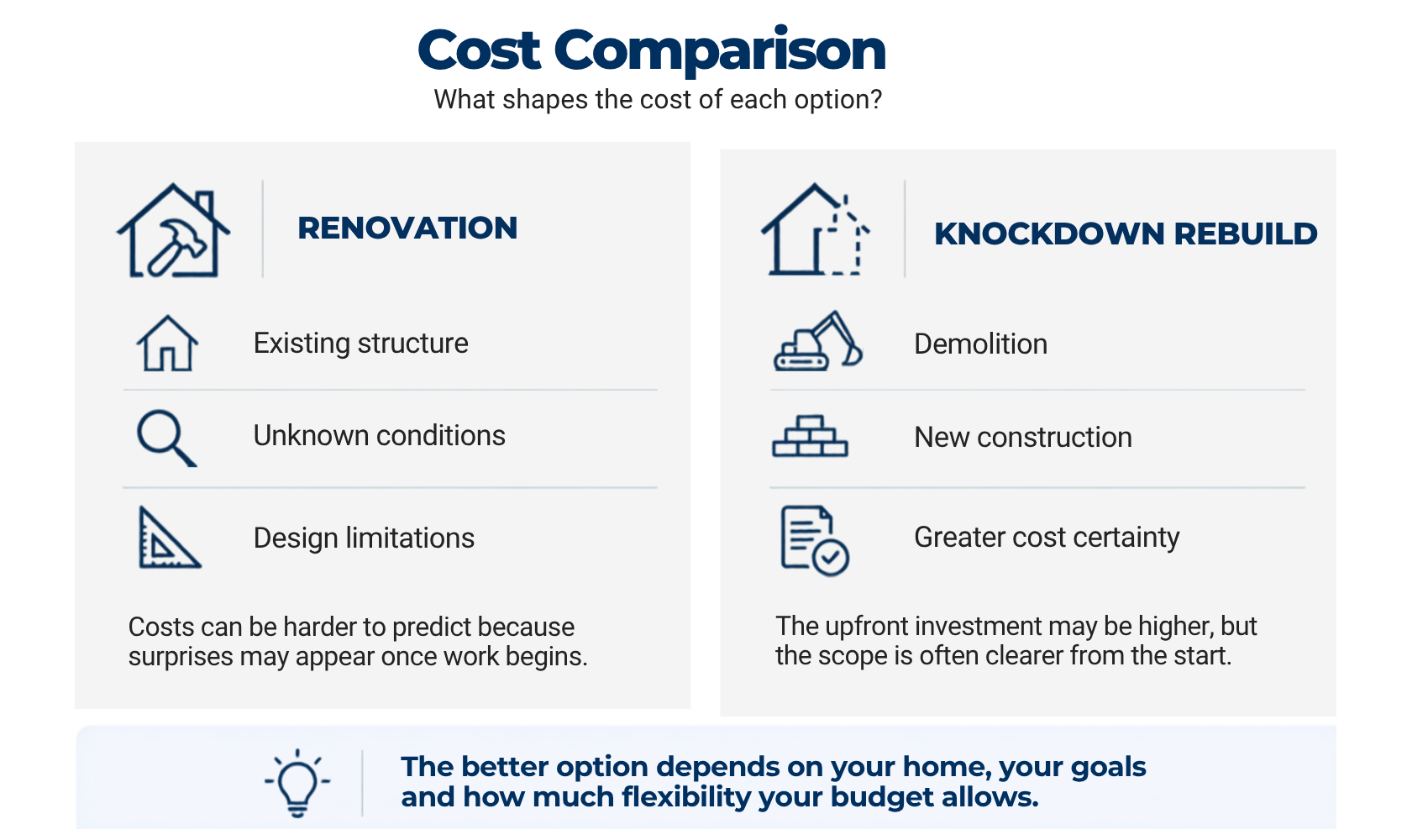
There are additional upfront costs associated with demolition and preparing the site, but the new home can then be designed as one complete building rather than being integrated into an existing structure.
That provides greater clarity around the scope of construction and allows the design, structure, services and finishes to be considered together from the beginning.
For homeowners considering a major renovation, it is worth comparing the total renovation cost against the total knockdown rebuild cost, rather than comparing individual construction items.
The important question is not simply:
Which option costs less?
It is:
Which option gives us the better home and greater long-term value for the investment we are making?
2. Timeline: How Does the Building Process Compare?
Time is another important consideration.
It is easy to assume that renovating will always be faster because part of the house already exists. That can be true for smaller renovations, but it becomes less predictable as the scope increases.
Renovation timelines
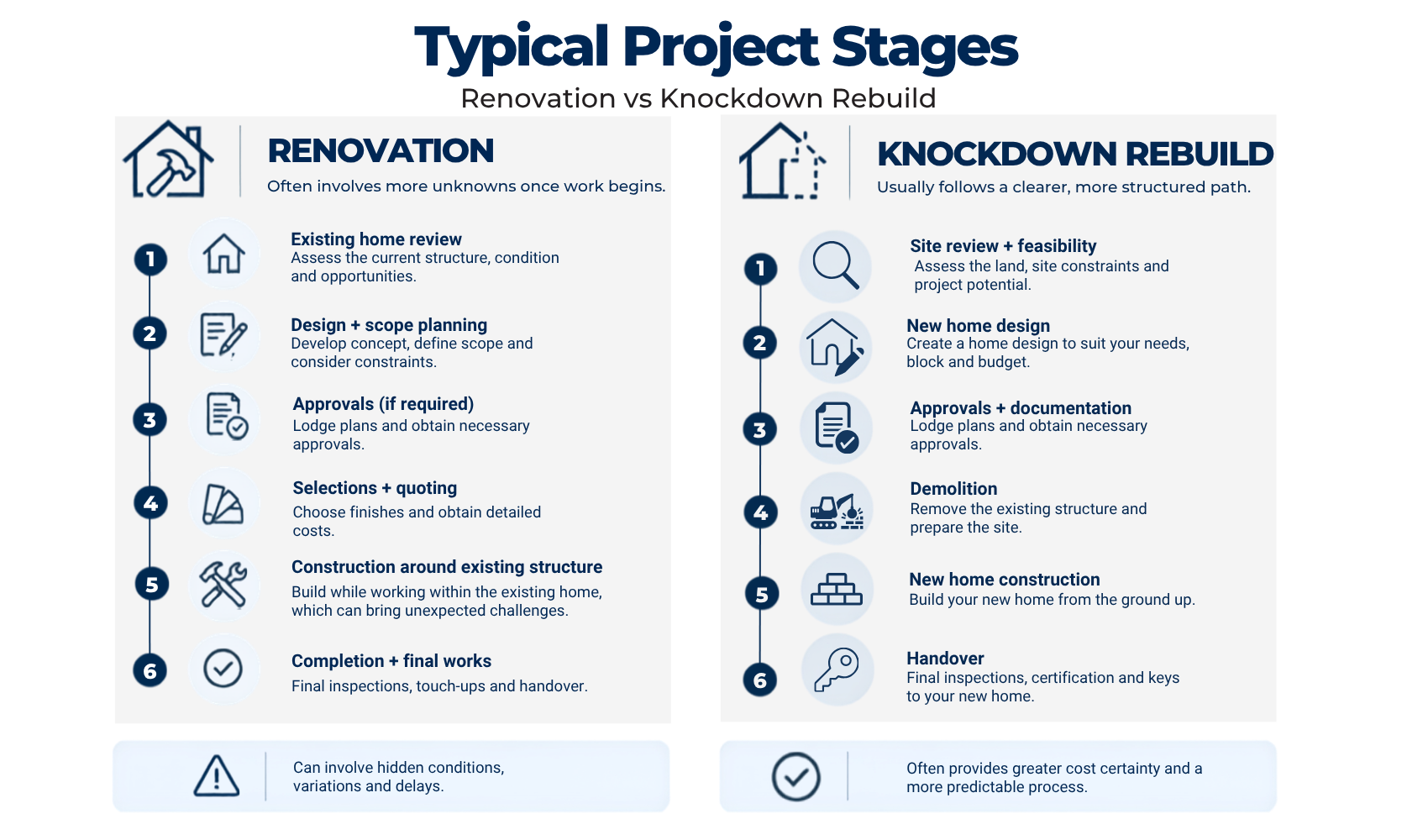
A renovation requires the project team to work with the conditions of an existing building.
Demolition may reveal issues that require additional work. Structural elements may need to be modified or strengthened. Existing services may need to be relocated or upgraded.
There is also the challenge of carefully sequencing new construction around the parts of the home being retained.
For a relatively contained renovation, this may be manageable.
For a major renovation involving extensive structural work, extensions and internal reconfiguration, the process can become much more complex.
Knockdown rebuild timelines
A knockdown rebuild requires more preparation before construction begins.
The process may include:
Site investigations and feasibility.
Design and documentation.
Planning and building approvals.
Demolition approvals and demolition.
Site preparation.
Construction of the new home.
While this can mean a longer pre-construction phase, once construction begins the builder is generally working with a completely new structure rather than integrating new work into an existing building.
The important consideration is therefore not simply how quickly construction can begin.
It is how predictable and manageable the entire project timeline is likely to be.
Good planning at the beginning of either option can significantly reduce problems later.
3. Outcome: What Kind of Home Do You Actually Want?
This is often the factor that ultimately determines whether homeowners should renovate or rebuild.
Before deciding, think about what you want your home to become.
Are you trying to improve the house you already have?
Or are you trying to create something fundamentally different?
Renovation works within an existing framework
Every renovation begins with constraints.
The orientation of the existing house, structural walls, ceiling heights, floor levels, foundations, plumbing locations and overall footprint can influence what is practical.
A good architect and builder can often work creatively within those constraints.
But there is still a point where adapting the existing building requires compromises.
Perhaps the bedrooms remain in the wrong location.
Maybe the main living areas cannot take full advantage of natural light or the backyard.
You might achieve additional space but still retain parts of the original floorplan that never worked particularly well.
If those compromises are acceptable, renovation can be an excellent option.
If they are not, it may be time to consider rebuilding.
A knockdown rebuild starts with your lifestyle
A knockdown rebuild gives you the opportunity to rethink the entire home.
Instead of asking how the existing house can be changed, you can ask:
What should this home be?
The new design can respond to the orientation and shape of the block, your family, entertaining requirements, privacy, natural light, storage and how you expect to use the home in the years ahead.
For homeowners planning a long-term or forever home, that freedom can be particularly valuable.
The result is not simply a newer version of the existing house.
It is a home designed specifically for the people who will live in it.
When Should You Knock Down Rather Than Renovate?
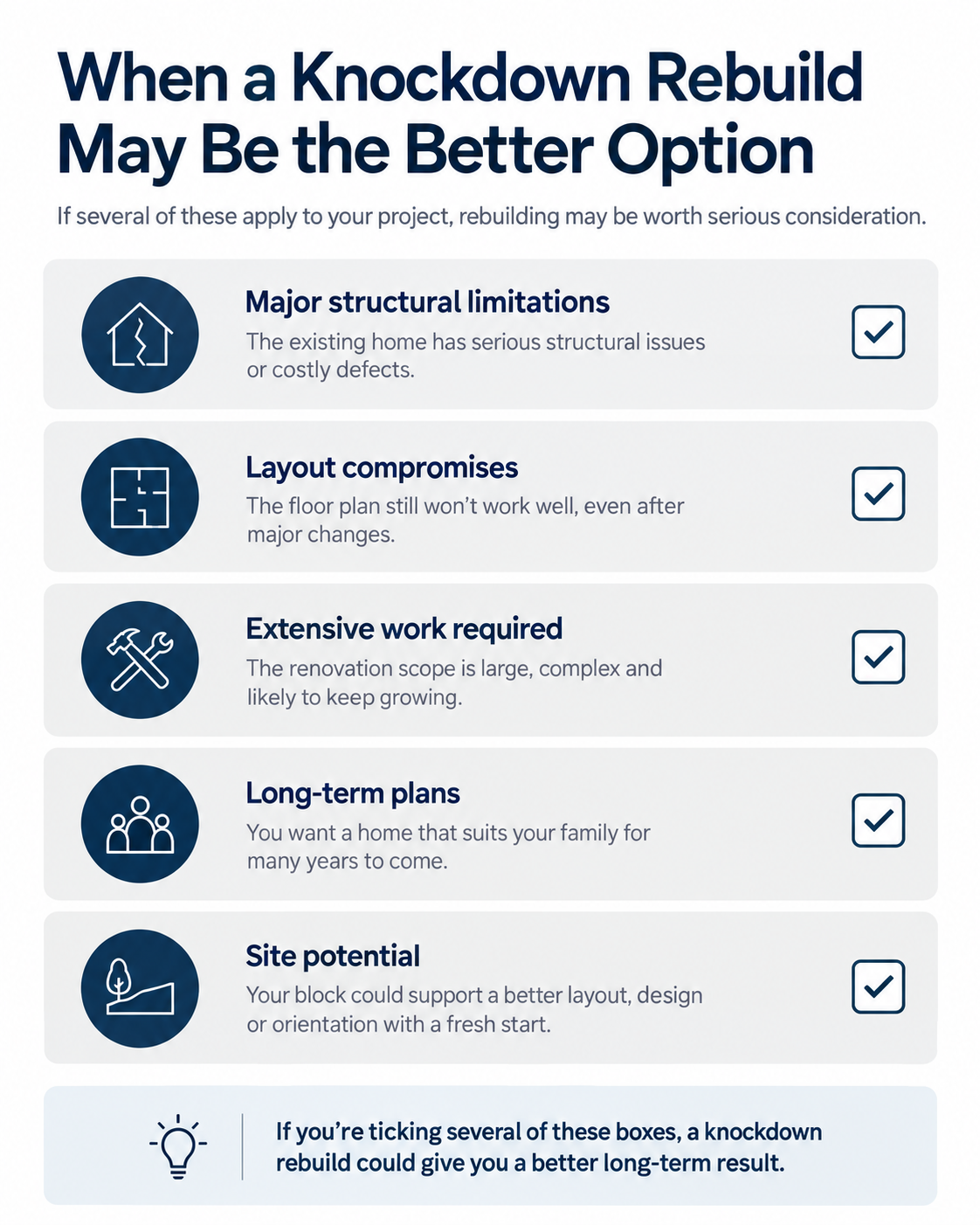
There is no single rule that applies to every property, but there are several signs that a knockdown rebuild deserves serious consideration.
It may be worth exploring when:
The existing floorplan requires extensive changes.
Significant structural work would be required throughout the home.
The property needs major upgrades to services or building systems.
You want substantially more floor area.
The existing orientation prevents the home from making good use of natural light or outdoor areas.
You are planning a long-term family home and do not want to compromise on layout.
The renovation is becoming so extensive that relatively little of the original home would remain.
It may be worth exploring when:
The existing floorplan requires extensive changes.
Significant structural work would be required throughout the home.
The property needs major upgrades to services or building systems.
You want substantially more floor area.
The existing orientation prevents the home from making good use of natural light or outdoor areas.
You are planning a long-term family home and do not want to compromise on layout.
The renovation is becoming so extensive that relatively little of the original home would remain.
A useful question is:
How much of the existing home are we genuinely trying to keep?
If the answer is very little, comparing the project with a new build can provide valuable perspective.
Case Study Comparison: Major Renovation vs Knockdown Rebuild
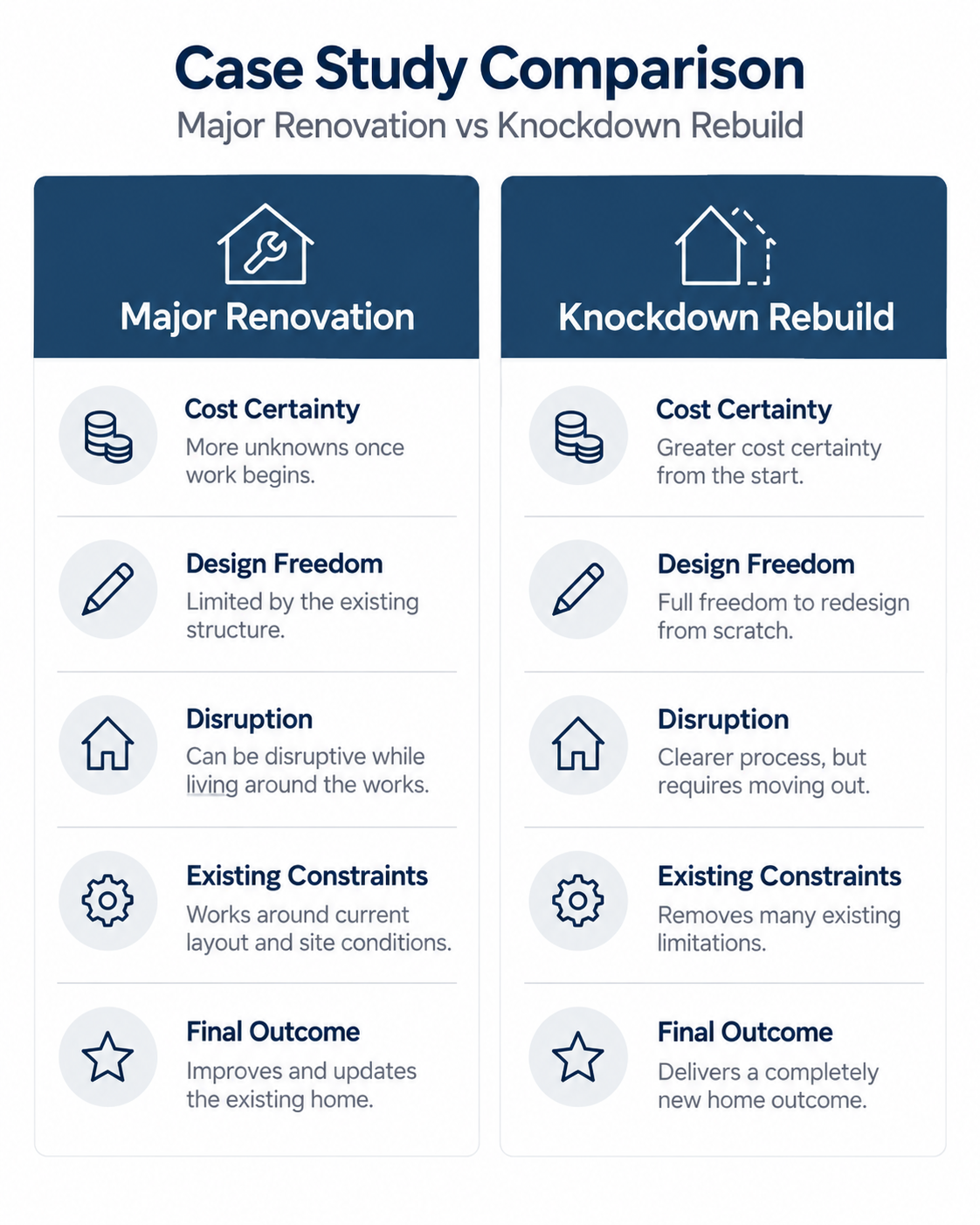
Consider two homeowners with similar blocks and similar ambitions for their finished homes.
Homeowner A: Major renovation
The existing house is structurally sound and positioned reasonably well on the block.
The homeowners like several elements of the original home but want a larger kitchen and living area, additional bedroom, improved connection to the backyard and updated bathrooms and finishes.
The existing structure can accommodate those changes without completely reworking the house.
In this situation, renovation may provide the right balance between retaining what already works and improving what does not.
Homeowner B: Knockdown rebuild
The second property is also in a location the owners love, but the house itself presents more challenges.
The floorplan does not suit the family. The living spaces have poor orientation, major structural changes would be required, and the owners want considerably more space.
By the time the proposed renovation is mapped out, almost every part of the existing home would need to be altered.
In this situation, a knockdown rebuild may offer a clearer path.
Instead of investing heavily in overcoming the constraints of the existing house, the homeowners can design a new home around the site and their lifestyle from the beginning.
The key difference
Both homeowners want to improve their property.
But they are starting from very different buildings.
That is why there is no universal answer to the renovation-versus-rebuild question.
The condition and potential of the existing home matter just as much as the vision for the new one.
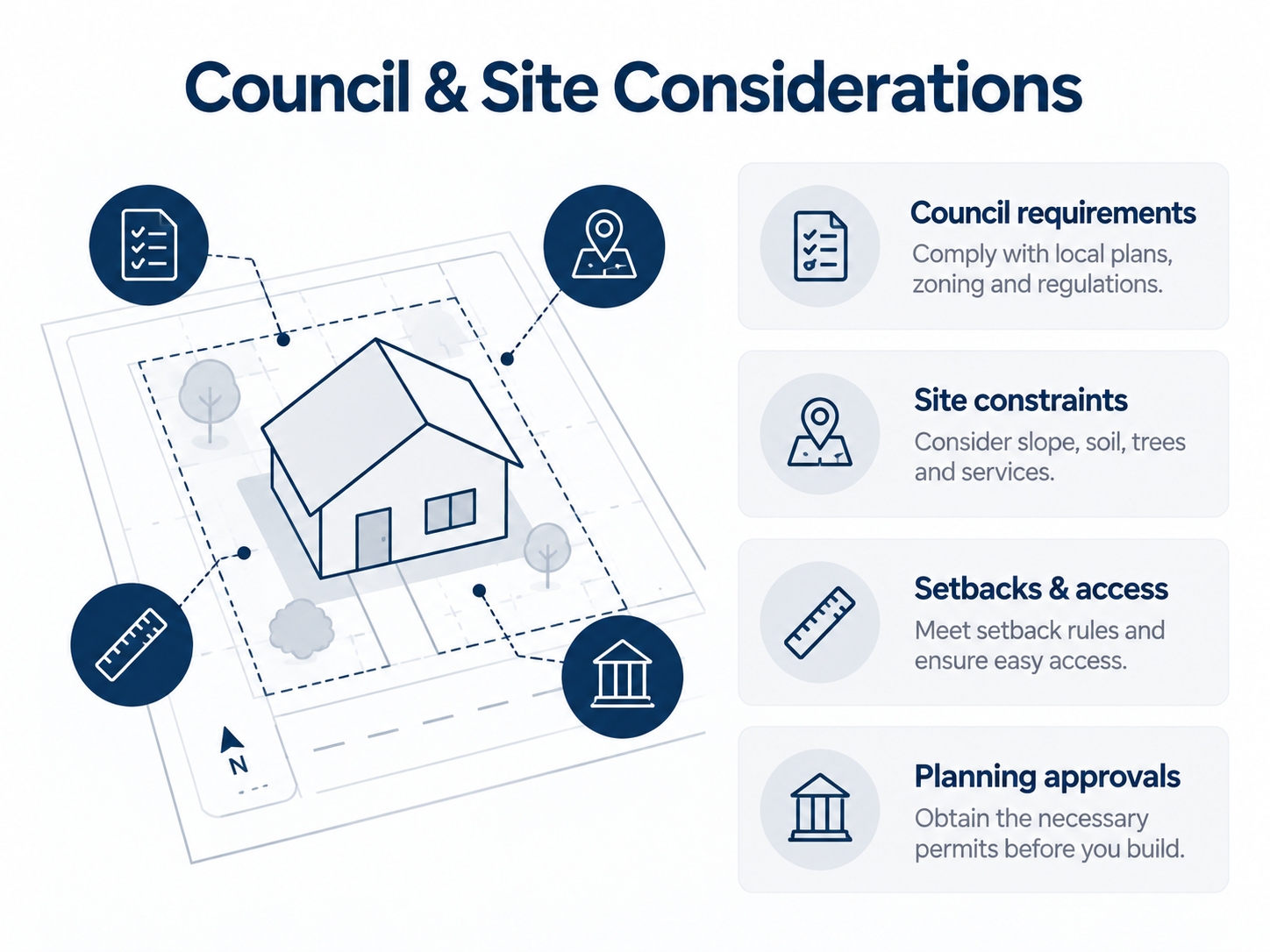
Council and Site Considerations
Before deciding to knock down and rebuild, it is important to understand what can actually be built on your property.
Owning a block does not necessarily mean you can replace the existing home with anything you choose.
Planning controls and site conditions can influence the size, position and design of a new home.
Depending on the property and proposed design, considerations may include:
Zoning and applicable planning controls.
Building height.
Floor space and site coverage.
Setbacks.
Heritage or conservation requirements.
Bushfire or flood considerations.
Trees and landscaping controls.
Stormwater requirements.
Access and site constraints.
Easements and existing services.
Demolition requirements.
Whether the project follows a complying development or development application pathway.
The requirements vary from property to property, which is why early feasibility work is so important.
The same applies to renovation.
Extensions and major structural alterations may also require planning approval and need to comply with current building requirements.
Before spending heavily on design, it is worth understanding the planning and construction constraints that apply to your site.
Why Early Builder Involvement Matters
Whether you are renovating or rebuilding, one of the most useful things you can do is involve your builder early.
Architects and designers naturally focus on creating the best design response.
An experienced builder adds another perspective: how that design will actually be built.
Early builder involvement can help identify:
Buildability issues.
Site access challenges.
Structural complexity.
Construction sequencing.
Potential cost pressures.
Areas where the design could be simplified without compromising the outcome.
This becomes particularly valuable when you are still deciding between renovation and knockdown rebuild.
Instead of developing an entire design before discovering that it is difficult or expensive to construct, the architect, builder and consultants can assess the project collaboratively from the beginning.
Better decisions early can help reduce redesign, minimise unnecessary variations and create a more realistic project budget before construction begins.
So, Is a Knockdown Rebuild Worth It or Should You Renovate?
A renovation is often the better choice when the existing home has good bones, much of the structure can be retained and the layout can be adapted to achieve the outcome you want.
A knockdown rebuild may be the better choice when extensive structural changes are required, the existing layout creates major limitations or you want the freedom to design a completely new home around your site and lifestyle.
The decision should ultimately come down to three questions:
Cost: What will each option realistically cost once the full scope is considered?
Timeline: What does the complete planning and construction process look like?
Outcome: Which option will actually deliver the home you want to live in for the years ahead?
Sometimes the answer is clearly renovation.
Sometimes rebuilding provides far greater freedom and long-term value.
And sometimes the right answer only becomes clear once the existing home, site, planning controls and proposed scope have been properly assessed.
Start With a Site Feasibility Review
If you are trying to decide between a knockdown rebuild vs renovation, you do not need to make that decision based on assumptions.
At Caton Constructions, we work with homeowners across the Sutherland Shire and surrounding Sydney areas to understand their site, project goals and the practical considerations that may influence the best way forward.
Our approach is collaborative from the early planning stages, bringing buildability, budget and construction experience into the conversation before major decisions are locked in.
A site feasibility review can help you better understand what may be possible on your block and whether renovating or starting again is likely to provide the stronger outcome.
Planning a major renovation or knockdown rebuild? Start your project with Caton Constructions and let’s explore what is possible for your site.